“I suffer from life and from other people. I can’t look at reality face to face. Even the sun discourages and depresses me. Only at night and all alone, withdrawn, forgotten and lost, with no connection to anything real or useful — only then do I find myself and feel comforted.”
Fernando Pessoa, The Book of Disquiet
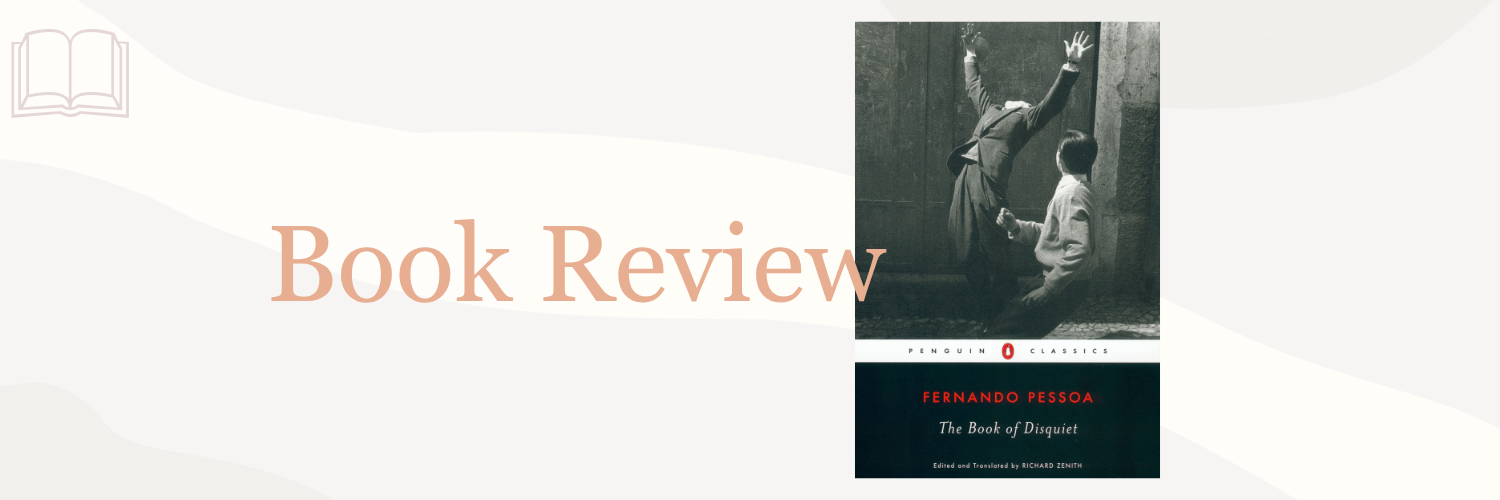
Title: The Book of Disquiet
Author: Fernando Pessoa
Genres: Classics, Philosophy, Poetry
Pages: 544 (Paperback)
Published: 1982 (Posthumously)
My Rating: ★★★★¼
Read: 5/16/2026 – 6/9/2026

Review:
I’ve wanted to read this book for so long but I felt so intimidated by it. Given it’s one of those niche classics, I was so excited when an opportunity for a buddy read came along. I was glad to be able to go into it with someone and to be able to have discussions about it. To my surprise, the fragmented style and lack of a cohesive plot weren’t difficult to follow. The absence of an outward premise is filled by an internal monologue that often has a way of crawling into the recesses of the reader’s brain, putting the nuances of the human experience into words.
Published posthumously and dubbed ‘a factless autobiography’, Fernando Pessoa gives readers a glimpse into his interior life rather than his exterior through his alter ego, Bernardo Soares. He muses on topics of society, human interaction, religion, books, nature, emotion, dreams, travel, past, future… there’s not much that he doesn’t touch upon. Something interesting about this book is that it can be read in any order. There is no chronological timeline and there are barely any characters to follow.
This is one of the most interesting books I’ve ever read. Not so much for the content itself, but because of Pessoa’s mind and thought processes. There are a few fragments in the book where he mentions his future readers and how they will appreciate his writing more than the people of his time. His ability to perceive the future is astounding.
As interesting as I found the book to be, it could be equally as bizarre. I don’t know if it’s included in every edition, but Advice to Unhappily Married Women was disturbing, for lack of a better word. It felt out of place with the rest of the book, and frankly, made me like the rest of the book a little less.
As an introvert myself, I could relate to a lot of the sentiments made throughout the book. For example, the way Soares approached social interactions and self-image was painfully familiar. However, it was not entirely like looking in a mirror, which was encouraging. Introversion in this book was exhibited at an unhealthy level, with Soares constantly making arguments for why it is better to live entirely in the mind rather than build relationships with anyone. This philosophy also applies to life experiences, preferring to stay held up in his room and sleeping (or specifically dreaming) whenever possible.
Overall, I did thoroughly enjoy the book, even with the off-putting moments. Though a lot of classics can be read nowadays and be considered challenging for the time it was written, this is one that I’d consider to still be challenging to this day. This, along with the author’s history, makes it a standout.
Likes & Dislikes:
What I liked:
- The chaotic and introspective writing.
- The lack of organization and cohesion is a plus in this book
What I didn’t like:
- Some of his takes were… interesting.
- Overall, I felt sad for Pessoa’s life, because he clearly had a brilliant mind.
Afterthoughts:
This was a buddy read with my friend Bella!
Leave a Reply