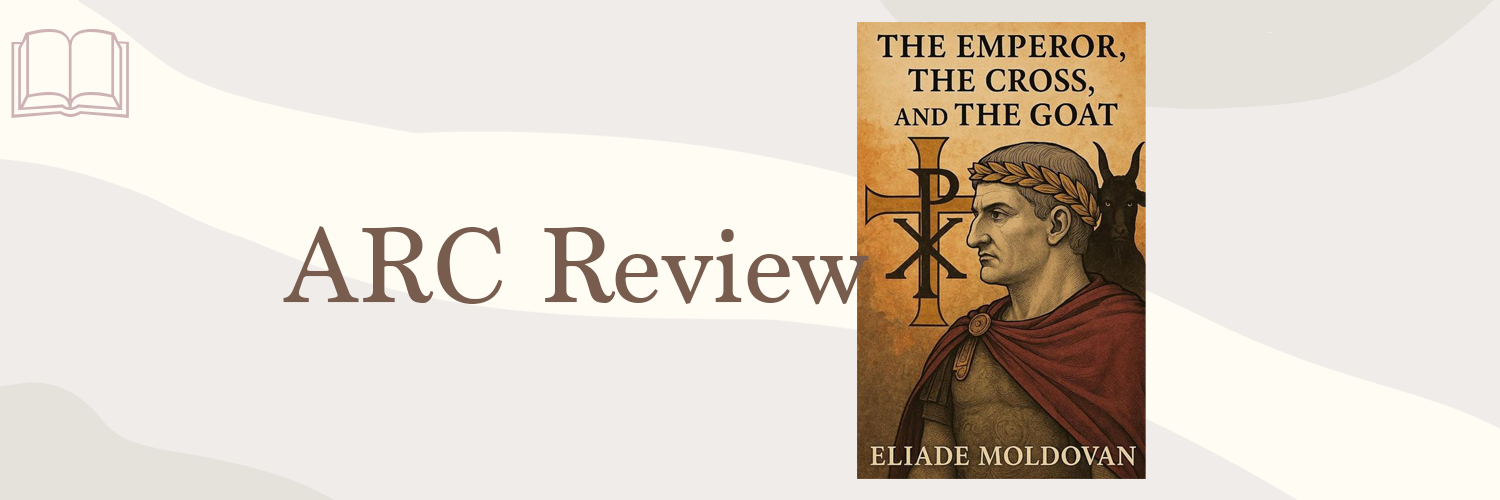
“The statue of Apollo gleamed in the sun. And the Cross waited, patient, just beyond the crowd.”
Eliade Moldovan, The Emperor, The Cross, and the Goat
Title: The Emperor, The Cross, and the Goat
Author: Eliade Moldovan
Genre: Historical Fiction
Pages: 215 (ebook)
Publish Date: August 24th, 2025 (Reedsy Discovery)
My Rating: ★★★¾
Read: 7/25/2025 – 7/28/2025

Review:
A couple of years ago, I read Helena by Evelyn Waugh, which is another book that draws from the time of Emperor Constantine. When I saw that The Emperor, The Cross, and the Goat was also set in this era, I was immediately intrigued. Instead of an emphasis on St. Helena’s life, it’s centered around Constantine. As I read on, I realized it not only focuses on him, but his counterparts as well.
Showing Constantine from a young age, the story follows him through his struggles with his spirituality. He’s drawn to the Christian faith like his mother, but reluctant to obliterate his pagan roots. This back and forth follows him throughout his life. In opposition to the relatively new concept of Christianity, we see the perspective of the pagans. They resent Constantine and his newfound ideologies and seek to preserve their gods and traditions.
I found the book to be more philosophical than plot-centered. The chapters were short, not allowing much time to bond with the characters. Aside from being a work of philosophy and a fictionalization inspired by real people and historical events, I’m not sure how to categorize its genre. I saw it listed under the Christian category, however, I would personally be hesitant to label it as such. I felt there to be more of a focus on paganism and mythology than on being a story rooted in Christianity and practice.
I enjoyed the contrast of ideologies the author captured. I haven’t read another book quite like it. (Dare I say, I was more invested in this than Helena!) I did find myself struggling to get into the rhythm of the story due to the brevity of the chapters and the different/sporadic points of view. Once I did, I was less intimidated by the overarching themes. I would recommend that readers have at least basic knowledge of this period of history to get the most out of it and to avoid any possible confusion about what’s fact and what’s fiction.
Thanks to Reedsy Discovery for providing a free digital ARC of the book!
Likes & Dislikes:
What I liked:
- Unique. I don’t think many authors would have attempted such a detailed discussion on Christianity vs. paganism in this context.
- Accessible language for the subject.
What I didn’t like:
- Extremely short chapters with little cohesion to the storytelling.
- Confusing. I’m still not sure which side of the argument the author is on.
- I can only speak for how it was categorized on Discovery, but I probably would not have picked up this book if I’d realized it was not wholly Christian fiction. While I found enjoyment in it for what it was, it left me unsettled.
Afterthoughts:
I’m not extremely well-versed in this time period, so I didn’t want to point out my suspicions on inaccuracies in my main review, however, one thing that jumped out at me was a statement that the Catholic Church does not recognized Helena and Constantine as saints. It may have been the wording, but I’d like to clarify that the Catholic Church does recognize St. Helena (of the Holy/True Cross), but not Constantine.
Where to buy the book:
(coming soon)
Leave a Reply